Colombian Coffee: A Balance of Tradition and Innovation
At SCAJ2024, following the Nicaragua seminar, I attended a seminar on Colombian coffee. Colombia is one of the origins that Botarhythm simply cannot do without. This seminar offered a great deal of insight into the challenges facing Colombia's coffee industry, and the innovative efforts being made to address them.
Beautiful green beans, and the effort behind them
The Colombian green beans I source are striking enough to catch the eye the moment the burlap sack is opened. Their appearance speaks to the tremendous effort put in at origin. In fact, Colombia's coffee industry continues to work tirelessly toward improving quality, and this seminar let me see a part of that firsthand.
2024 harvest expected to be strong
Early in the seminar, it was shown that the 2024 harvest is expected to be strong. This is very good news. That said, climate change has had an impact in the past. From 2021 to 2022, Colombia experienced a difficult period under the influence of a strong La Nina event. Current annual production is estimated at around 12.5 to 13 million bags.
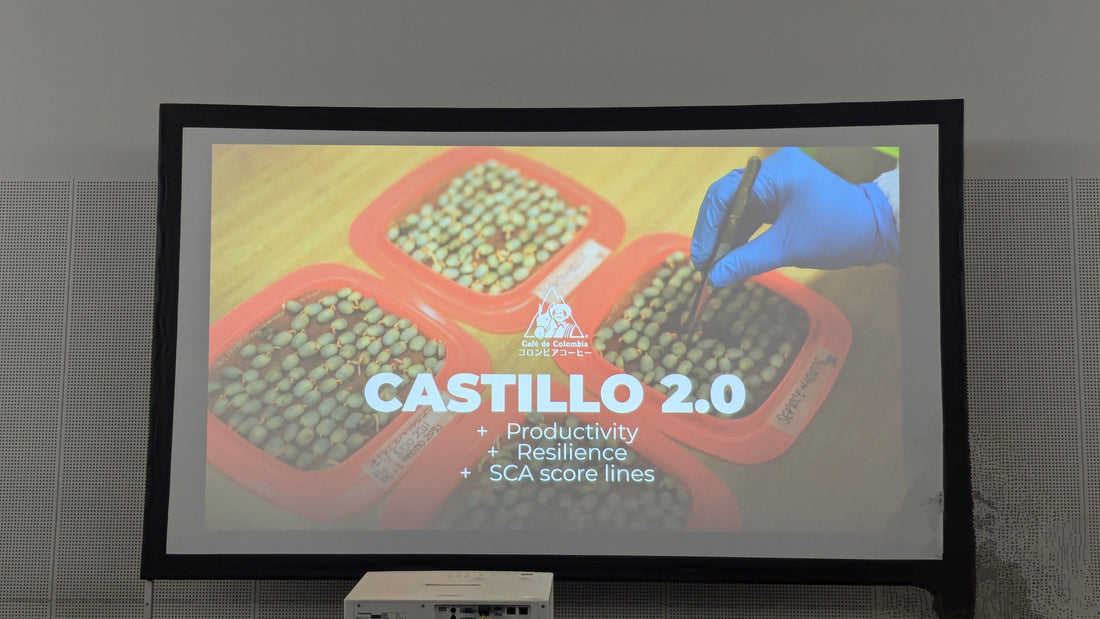
CASTILLO 2.0: a new variety looking toward the future
What stood out most to me in this seminar was the chance to taste a new variety called "CASTILLO 2.0." This variety shows strong resistance to climate change, a global challenge, as well as to coffee leaf rust, a serious threat to coffee trees. It will still be several years before it reaches the market, but being able to directly sense a ray of hope for coffee's so-called "2050 problem" was a real takeaway.
Commitment to sustainability
Colombia's coffee industry is focused on three pillars: quality, environment, and sustainability. Specific efforts include the following:
- Centralizing wet mills: improving working conditions for producers, standardizing quality, reducing environmental impact, cutting costs, and improving traceability
- Responding to EU regulations: building traceability systems aimed at deforestation-free coffee production
- Sustainable farming practices: coffee tree renewal programs, proper fertilization planning, and improved water resource management
- Climate change adaptation and mitigation: introducing new varieties, improving farming practices, and implementing forest protection and regeneration programs
A deep relationship with the Japanese market
The seminar's presenter, who has more than six years of experience with the Japanese market, spoke of placing great importance on collaboration with Japanese buyers. To meet Japan's high quality standards, particular focus is being placed on improving wet processing and quality control.
Looking ahead
Through the spread of new varieties, further centralization of wet mills, and strengthened traceability systems, Colombia's coffee industry is working to maintain its competitiveness in the international market. These efforts aim to sustain high quality coffee production while responding to climate change and the demands of the global market.
This seminar gave me a renewed appreciation for the appeal of Colombian coffee and the effort of the many people behind it. At Botarhythm, I will continue working alongside Colombia's producers, striving to bring you a wonderful coffee experience.

![[First-time only] Botarhythm Tasting Set of 3 (80g each) | Botarhythm specialty coffee](http://botarhythm.com/cdn/shop/files/LP_main.png?v=1765364144&width=480)


