
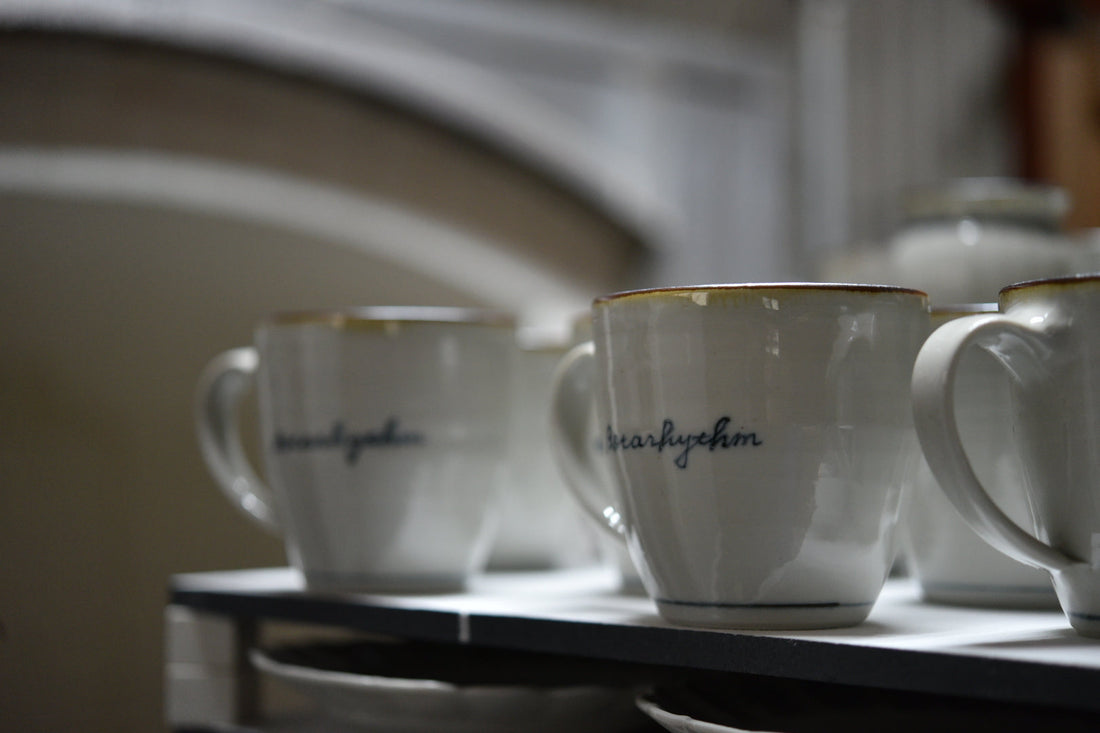
Awan Kiln x Botarhythm collaboration mug
A vessel that pours the memory of the countryside: a bond beyond words, woven by Botarhythm x Kazuaki Shimura

A blue gradient that catches the morning light. A mug that sits as quietly as the deep sea at dusk.
This mug is not just a vessel. It is a special presence that accompanies daily life and colors the time spent with people who matter. Born from a dialogue between Botarhythm Coffee Roaster and potter Kazuaki Shimura in the quiet countryside of Minamiboso, it also serves as a medium that deepens the connection between coffee and people.

Two makers in the countryside, nurturing a connection
In the countryside of Minamiboso City, where only birdsong and the sound of the wind break the silence, stands Shimura's workshop. Built beside his own home, it is here, day after day, facing the clay, that his vessels come into being.
At Botarhythm, I believe that coffee creates connections that go beyond words. Coffee is not just a drink. It takes on special meaning depending on who is tasting it, at what moment, and with what feelings. And Shimura's vessels are a presence that elevates that coffee experience into something richer.
Shimura and I live as neighbors in the same city of Minamiboso, and we see each other often in daily life. We have brewed handmade soy sauce together, shared the bounty of the countryside and the sea, and talked through the worries of raising children. During the pandemic, we co-hosted a craft market called "awan market," building connections with people in the area through making things together.

The moment the kiln opens: a story told by a one-of-a-kind blue
"So this is what a month of preparation was leading up to."
That was the thought that came to me when the kiln door was opened. Not only the original mugs but many of Shimura's other pieces emerged fired and neatly stacked in tiers, and among them stood the mugs, fired into a beautiful blue.

"This looks like the sky, and it looks like the sea too. It even gives you the feeling of diving into the deep ocean."
As I let out a sound of admiration, Shimura nodded back, satisfied. This blue was no accident. It came from precise calculation, experience, and the convection of heat and time inside the kiln. The flow of the glaze, the convection of the flame, and the delicate balance of firing temperature all came together to produce this expression.
Two kinds of mugs were completed this time.

One is an update of an earlier design: a blue glaze over white porcelain, engraved with the trademark and the word "Botarhythm."
The other is a new, smaller mug. Its entire surface is dyed in a blue gradient, marked by a beautiful depth of color.
These mugs are sold in limited numbers at Botarhythm's shop and online store, becoming a special presence that accompanies customers' daily lives alongside their coffee.

A story in a cup, born from handwork
"What are the rough steps and process involved in making a single piece of tableware?"
That was the question I asked Shimura at the start of the interview.
"First, I shape it on the wheel. After letting it dry to the right degree, I trim the base and attach the handle. The timing of attaching the handle matters. If it dries out too much, it doesn't work. I do the trimming and shape the expression while it still has some moisture left."
Shimura uses a special white-firing clay ordered from the Kutani ware region of Ishikawa Prefecture, shaping it on the wheel.
He says the image of a piece begins with the choice of clay, and he has consistently used the same clay throughout. It seems this lets him concentrate on his own expression.
In this sincere way of facing the material, I feel the essence of making things. At Botarhythm, I also face the material of coffee beans sincerely, valuing the work of drawing out their character as fully as possible. Listening to the story a material has to tell, and finding joy in giving it form: perhaps that is a value Shimura's pottery and Botarhythm's coffee roasting share at their root.

Trimming and decoration, the steps that shape character
A vessel's character comes from a variety of steps, and trimming is one of the important ones. "If it dries out completely, I can't do it, but this is trimmed with a light scraping sound while it's still fairly moist," Shimura says. His hand movements are delicate yet bold, and they draw the eye.
He then decorates the piece using a technique called "itchin." Using a tool like a thin dropper, he draws lines with clay in a slip-like state, in a manner much like a painter at work. Motifs such as birds and waves rise up in clay that looks almost like whipped cream.
Bisque firing and gosu, the moment color takes hold
Once dried, a vessel first goes through a process called "bisque firing" in an 800 degree kiln. "It hardens into something with the absorbency of a flowerpot, but because it still absorbs water, it's not yet suited for tableware," Shimura says. At this stage, with tiny pores still open across the surface, the piece moves on to painting.
Painting uses a pigment called "gosu," made mainly of cobalt, dissolved in water before use. "There are various materials besides cobalt," Shimura notes. Even among commercially available versions there is a wide range, from bluish to purplish to blackish tones, and some craftspeople adjust the composition to create their own original colors.
Glaze, wrapped in the shine of glass
After bisque firing, the vessel moves on to glazing. "Glazing is more like dipping than applying... it's a powder, but you mix various glassy materials and dissolve them in water," Shimura explains. Dipping the piece into the thin, watery glaze coats its surface.
At this stage, the painting that was done earlier disappears, covered by the white glaze. As if by magic, the image reappears only after firing. One characteristic of Shimura's work is the brown glaze applied to the rim of the mug's lip. This is a separate, iron-based glaze that adds a warm accent to the white porcelain.
"When I want to apply a different glaze to the inside and outside, I push right up to the edge," Shimura says. Making that adjustment takes a practiced hand.

Loading the kiln, the miracle made by flames at 1260 degrees
The final step is the main firing at a high temperature of 1260 degrees, a process that takes about eighteen hours. "1260 degrees is the peak stage. It's held at that peak for about an hour, and after that it cools down naturally and slowly," Shimura explains.
Temperature is measured using a tool called an "Orton cone," placed at the top and bottom of the kiln, with the degree of its bending used to judge the temperature. "I'm always watching it as a kind of graph, so I make adjustments once it tilts to about this point," Shimura says, his eyes full of the quiet confidence that comes from years of experience.

Convection inside the kiln, he says, changes greatly depending on how it's packed. "If the kiln is too empty, the temperature shoots up and the heat escapes upward," Shimura says. This time, since the lower section tends to stay comparatively cooler, the mugs with the blue design were placed lower in the kiln, on the prediction that the blue on the surface would flow more gently there.
Hearing this, I found myself agreeing: "With coffee beans too, how the heat moves depends on the volume of beans relative to the roaster." Different fields, yet the sense of facing fire and material in making things somehow connects. Just as when I roast coffee beans, once the beans themselves hold heat, that heat alone can push the color development further and further, so I control it with the amount of air. Hearing this, Shimura nodded along.

Stoneware and porcelain, the feel a material conveys
"What's the difference between stoneware and porcelain?"
To my question, Shimura answered like this.
"Stoneware is clay, porcelain is stone. Porcelain has a higher density, it's smooth, and it doesn't absorb water. Stoneware has a warmer texture, while porcelain gives a sharper impression."
All of Shimura's work is classified as porcelain. It's characteristically smooth to both the touch and the eye, and it doesn't absorb water even without a glaze, once it's been fired hard.
This mug is marked by the translucent blue unique to porcelain. You can enjoy the nuances of color that shift with the light.
This difference in texture also affects the experience of tasting coffee. The smooth feel of porcelain against the lips lets you sense the delicate aroma and nuances of coffee's flavor more clearly. Just as city life and nature can exist in harmony, this mug brings together modern beauty and the warmth of nature.

Beyond the name, craftsman or artist
One of the most interesting parts of the interview was our conversation about the two concepts of "craftsman" and "artist."
"A craftsman is maybe someone whose skill is so refined within themselves that they can make exactly what they're told, down to the last detail," Shimura said. "An artist feels a bit freer, more like someone building a world with their own originality."
Interestingly, though, Shimura himself doesn't even call his own pieces "works of art." He'll say "vessels" or "pieces," but apparently he doesn't call them "products" either.
"I have no intention at all of making art, and I'm not an artist," Shimura says. So how does he think of his own occupation?
"I don't think I'm a craftsman either. Honestly, I think the best fit might be 'ceramics manufacturing.'"
This phrase, he says, comes from words attributed to the well-known potter Kanjiro Kawai. The story goes that when his child asked, "What should I write for Dad's job?" he answered, "Just write 'ceramics manufacturing.'"
Comparing it to the difficulty of naming yourself a photographer versus a photograph-taker, our conversation about the discomfort of being categorized reflected a worry shared by anyone involved in creative work.
"I don't really have that kind of title for myself. If someone asks 'what do you do for work?' I'm about the level of saying 'I make plates' or 'I do pottery.'" In Shimura's words, there is a stance that values the actual hands-on work itself more than any title.
I found myself agreeing: "When someone asks me what kind of shop I run, I say 'I'm a coffee shop,' but I would never say 'I run a cafe business.'" Neither of us seems bound by the world's expectations or frameworks. We each seem to be quietly, but surely, following the path we believe in. Being able to talk about the essence of handwork in the course of everyday life is one of the great riches of living in this countryside.

A story spun by hand and clay, an encounter with pottery
What led Shimura onto the path of pottery was a design vocational school he attended after graduating high school. "There was a pottery class among the courses. It was a vocational school where you learned various crafts, and of all of them, pottery interested me the most," he says.
What especially captured him, he says, was the feel of the clay and the moment of creation through the wheel's rotation. "The feeling of touching soft clay felt good, and it was interesting how, by spinning the wheel and applying force, it would take shape." His words convey the primal joy of making things.
After that, he went on to a school in Kyoto, where in an environment meant to train craftsmen, he gained experience "quietly making about a hundred of the same thing." At the time, he thought that if he could master craftsman-like work, things would somehow work out.
But as he gained experience in Ishikawa and Mashiko, Shimura's feelings began to shift. "It was after I went independent," he says, that he began painting, prompted by a conversation with a senior. "It became a conversation about differentiation, or rather identity: 'why does Shimura make this?' And we talked about how I might make use of the experience I built up during my training years in Kyoto and Ishikawa."
It was likely from this turning point that Shimura's own style came to take shape. "Some people do both stoneware and porcelain, but I work in porcelain, and I've come to center my own expression around it as well." His words reveal the sincerity of a creator who moves forward while facing his own sensibility.

The puzzle of loading the kiln, a dialogue with time
At Shimura's workshop, loading pieces into the kiln is also an important step. "It's kind of like a puzzle," Shimura laughs. "I really push it to the edge and pack in as much as I can," he says, his eyes turning serious.
Because pieces shrink when fired, they are even larger before going into the kiln. "It's actually a bit more of a tight squeeze than this," he says. "Since I want to fit in as much as possible, I make fine adjustments right up to the very end." His words convey the wisdom of a craftsman balancing efficiency and quality.
The time it takes to make enough work for one kiln load is, he says, "about a month, up to today." Hearing this, I found myself marveling: "To someone who doesn't know the whole process, it might seem like a lot to make in a month, but it's also the amount of work that's the limit of what can fill this kiln in a month."
This one month was never made up only of regular, orderly hours. When I mentioned, "Sometimes when I come home late, I notice the workshop light is still on," Shimura answered, "In the end I have to make the deadline, so I'm always thinking, 'will I make it in time?' but in the end I adjust things so that I do."
Our conversation turned to how having a fixed deadline naturally sorts out your priorities in the work, and I laughed and agreed, saying, "Tax filing season is like that every year too." Shimura's words, "That's part of the appeal too, doing it yourself," conveyed the resolve and pride of someone engaged in creative work.
As fellow sole proprietors, we share that feeling of creating at our own pace while still being chased by deadlines. In the countryside of Minamiboso, while raising children, we share, day by day, both the joy and the hardship of continuing to make things.

The moment of completion, vessels born from the kiln
After a long process, two kinds of mugs were finally taken out of the kiln. A larger mug where the blue pattern stands out against a white ground, and a smaller mug entirely dyed in a blue gradient, each giving off a different kind of charm.
To Shimura's question, "How's the size?" I answered with satisfaction, "The last one was good, but I think this time's is even better. Before firing it was more elongated, but it's come out rounder. It looks great lined up next to the bigger one, and this color is really wonderful. I'll let the people looking forward to this know first."
In this exchange, you can feel both the confidence in a piece born from the fusion of a craftsman's skill and sensibility, and the consideration for the people who will use it. The kiln opening that day was a special moment for me too. It carried a tension and joy different from the casual conversations we exchange as neighbors in everyday life.

A vessel that pours a connection beyond words
This mug is not just a vessel. It is a presence that enriches the time spent tasting coffee.
A moment in the morning, watching steam rise slowly by the window. An afternoon spent on a day off with a favorite book in hand. A night of talking things through with someone, easing the mind. This mug should make such small, everyday moments a little more special.
At Botarhythm, under the idea of making a single cup richer with exceptional coffee beans, I want to create valuable time not only on special occasions but within everyday life. Responding to voices like "I want to drink this with my family," "I want to give this to a friend," or "I want to treat myself," I believe coffee can be a presence that accompanies each person's daily life. Whether at the shop or online, I hope that coffee can enrich people's individual time and their relationships with those who matter, bringing warmth and a sense of ease into their lives.
This collaboration mug with Shimura is a piece that gives form to that hope. Without pushing specialized knowledge about how coffee should taste, my wish to offer an environment where people can simply enjoy it comfortably is expressed in this vessel as well.
I feel that the conversations exchanged day to day, and the realizations born from time spent together, living in the countryside of Minamiboso, are naturally woven into this mug. The time built up through everyday moments, sharing handmade soy sauce, the bounty of the countryside, and the gifts of the sea, seems to form the foundation of this collaboration.
Just as coffee creates a "connection beyond words," this mug too should speak quietly to the heart of the person using it, and create a special moment.
About the collaboration mug
Available at: Botarhythm Coffee Roaster shop and online store
Made by: Kazuaki Shimura
Material: Porcelain
Firing temperature: 1260 degrees
At Botarhythm Coffee Roaster, alongside coffee beans, a limited number of collaboration mugs with Kazuaki Shimura are available. Please check the shop or the online store
for details.
Interview profile

Kazuaki Shimura instagram: @kazuakishimura
Born in 1979 in Tateyama City, Chiba Prefecture. After devoting himself to judo at Awa High School, he went on to a design vocational school in Tokyo. At age twenty five, he reached a turning point in his life and set out on the path of pottery. He began learning the fundamentals of pottery in Kyoto in 2004, and in 2006 studied under Kutani ware potter Shunzo Masaki in Ishikawa Prefecture. In 2008 he trained at the workshop of Kengo Wakabayashi in Mashiko, Tochigi Prefecture, and went independent in Mashiko in 2012. In 2014 he moved his kiln to his hometown of Tateyama City, Chiba Prefecture, and relocated to Minamiboso City in 2019. In 2021 he moved the workshop that had been in Tateyama onto the grounds of his home in Minamiboso City, setting up a workshop he named "awan kiln."
Guided by the belief in "making warm vessels that draw on the good of old things while suiting modern life," he creates work using a variety of techniques, from images drawn in gosu blue on a plain white ground to blue and white porcelain and iron-painted stoneware. Fusing the experience gained across the different pottery cultures of Kyoto, Ishikawa, and Mashiko, he has established his own distinct style, producing vessels that add color to the everyday table.
Under a creative philosophy of "making vessels that bring out the best in food and add a little brightness to the everyday table, hoping that conversation and an enjoyable table will grow from them," he continues to make work that brings joy and a richer table to the people who use it.
(Written by Nobuaki Motozawa, Botarhythm Coffee Roaster)
Beans in the online store
For a first order, there is a tasting set of three roasts.
![[First-time only] Botarhythm Tasting Set of 3 (80g each) | Botarhythm specialty coffee](http://botarhythm.com/cdn/shop/files/LP_main.png?v=1765364144&width=480)


