
SCAJ2025 Report: Cup of Excellence and Japan's Journey
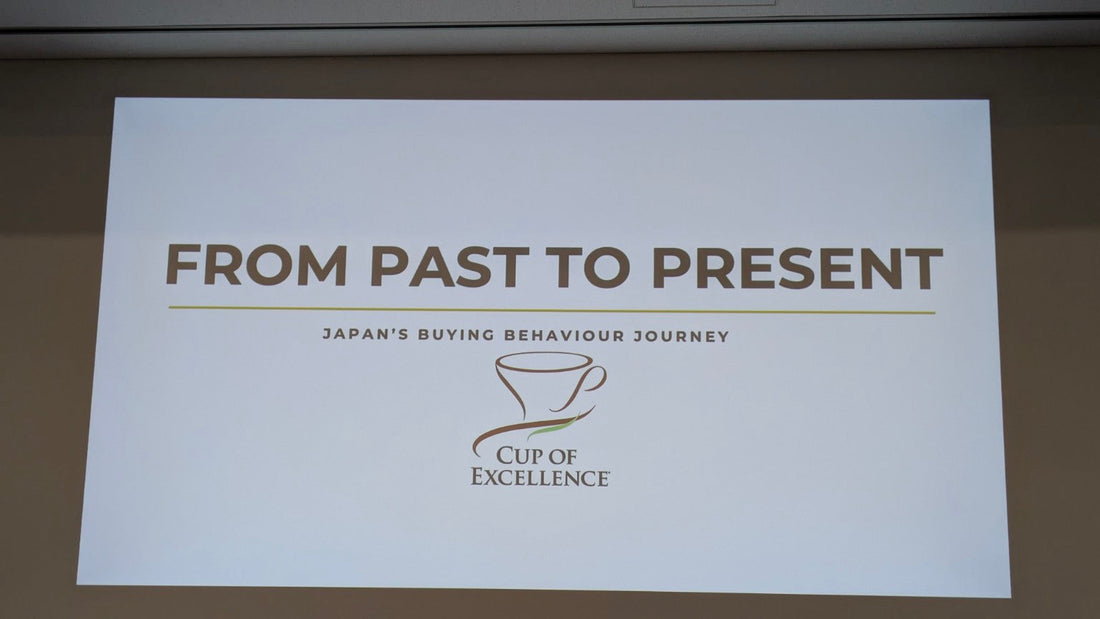
At SCAJ2025, I attended a seminar hosted by ACE (Alliance for Coffee Excellence) titled "From Past to Present: Japan's Buying Behaviour Journey."
The cup of coffee that first set me on the path to becoming a coffee roaster was a Brazilian Cup of Excellence winning lot I drank in the early 2000s. I touched on the impact of that flavor in an earlier article, and this seminar brought that memory back while reminding me how CoE has served as a guiding standard, contributing to both origins and the market. It was a rare chance to glimpse the workings behind specialty coffee as a system, something that's hard to see from the cupping table or the judging floor alone.

What is Cup of Excellence (CoE)
CoE (Cup of Excellence) is an international coffee competition that began in 1999. Held in each producing country, it selects the highest quality lots harvested that year and sells them at auction through an internationally recognized evaluation standard and a transparent process. To date it has raised over 90 million dollars (roughly 13.28 billion yen), with 75 to 80 percent of that amount returned directly to producers. It's a system that truly embodies the idea of "from producer to cup."

The transparency and rigor of the competition also stand out. From preliminary selection through roughly 3,600 cups tasted by 12 to 14 national judges, and on to the final round judged by international judges, a total of 8,720 cups are cupped to select each country's finest coffees. Even though a lot may be as small as around 300 kilograms, it undergoes an evaluation far more rigorous than the roughly 10 cups a large roaster might taste when buying by the container. On top of that, it isn't simply a contest for ranking quality. As a system in which effort is paid what it's worth, producers across 17 producing countries benefit economically as well.
Japan and CoE: from 1999 to 2025
Japan has taken part with a strong presence since the very first edition in 1999. Its share was around 75 percent of the whole in the early 2000s, around 50 percent between 2010 and 2018, and stands at around 35 percent today. The numbers may look like a decline, but this is said to reflect a market that has diversified and matured. The seminar repeatedly went into detail on how Japan's role within CoE has shifted over time. My own personal impression is that the effects of the pandemic in recent years, along with the subsequent weak yen, show through in this data as a decline in Japan's purchasing power compared to before.

The changing pattern of buying
- 1999 to 2018: Japan was a major buyer that supported CoE's founding years. Large scale purchasing helped stabilize the program and contributed to shaping a culture of quality.
- 2019 to 2025: A shift toward selective buying that values premium quality. A style of buying that maintains continuity and trust even in small lots.
Particularly notable is the "group buying" system that Japanese buyers began. Small and mid-sized roasters form groups and jointly purchase a single lot, making it possible to secure high quality coffee even in small quantities. This approach is said to now be spreading to countries around the world, including South Korea, Norway, and Australia.
Shifting market trends and the current direction
Recent trends in the Japanese market show some interesting changes. Looking at the period from 2018 to 2025, the number of lots purchased has declined, while average prices have trended upward. This reflects a shift "from quantity to quality," showing that Japanese consumers and roasters have come to make more discerning choices. Markets such as Taiwan, South Korea, and China now lead the way in price competition, while Japan is trusted as a market that values clean, stable quality.
Preferences in variety have also shifted. Bourbon (a traditional Brazilian variety) was popular in 2018 and 2019, Typica (a variety close to coffee's original wild types) drew attention in 2020 and 2021, and since 2022 Geisha (a rare variety originating in Ethiopia) has been gaining increasing interest. The flavor profile sought has also shifted, from what was once "refined balance" toward something now described as "elegant and exotic."
Cafe culture and buying with a story
Since the 2010s, the number of third wave style cafes in Japan has grown, and interest in traceability, in other words "coffee whose background you can see," has increased. This emphasis on story and empathy for the people behind the coffee mirrors a broader shift in consumption styles across Asia. For those of us who roast coffee, this points to the importance of proposing value rather than competing on price. The story of the origin, the producer's dedication, the character of the processing method, and the way flavor changes through roasting, conveying all of this carefully is, I was reminded, what leads to a true specialty coffee experience.

In 2019, Japan's annual coffee consumption reached 7.5 million bags (in 60kg bag equivalents), establishing its place as one of the world's leading coffee consuming nations. Its presence as a market continues to draw international attention.
Where Japan stands now: from quantity to quality
Japan, it's said, is now shifting its role from volume buyer to "refined curator." One thing that stood out in the seminar was a phrase Mary used, that "Japanese consumers are trained." I do find, in conversations with customers, that the attitude I encounter isn't "it's expensive so it must be good coffee," but rather an effort to understand why a particular coffee is special.
Purchase volume is on a downward trend. This shift doesn't only carry a negative side. Rather, she says, it shows the maturity of Japan's coffee culture and reflects the role it plays as a "benchmark of quality" within the global specialty coffee market. While emerging markets such as South Korea, Taiwan, and China lead the charge in price competition, Japan is establishing itself as a mature market that values quality and consistency. She also noted that competitions beyond CoE are increasing as well.
What Botarhythm took from this
Through this seminar, I found myself returning to the question of why I do this work in the first place. What drew me to that CoE winning lot was its remarkably clean cup (a clear taste free of off flavors) and a terroir, the flavor shaped by the character of the land, expressed so vividly. I still remember clearly how moved I was by the rich flavor that spread through my mouth and the long, lingering finish that seemed to never end.
Cup of Excellence isn't just a contest. It's a system that carefully illuminates the path by which a single coffee bean connects to the world. The producer's effort, a transparent evaluation, a cycle of continuous improvement in quality, and the people who believe in and support it. Seeing all of this laid out through concrete examples and figures left a deep impression on me, of the immense span of time, will, and intention behind a single cup.
Not a single bean that we roasters roast arrives in our hands by chance. How it was harvested, how it was evaluated, and the path it traveled to get here. Taking an interest in that background and deepening our understanding of it is, I'm reminded again, what allows a cup that properly conveys that bean's value to come into being.
Running a roastery in the nature rich surroundings of Minamiboso, I feel every day what it means to carefully roast coffee that carries a producer's effort and care. Perhaps the true value of specialty coffee lies in the connection that a program like CoE builds between producer, roaster, and ultimately, the customer.
At Botarhythm, I hold these lessons against my own sense of things, aiming for a coffee experience where every coffee carries a background and a story. Alongside keeping up with technique and information, I want that same care to come through in the words I share when talking with customers. I intend to keep learning, and to keep walking, quietly and steadily, as a bridge to coffee's producing origins.
Related articles
Beans in the online store
For a first order, there is a tasting set of three roasts.
![[First-time only] Botarhythm Tasting Set of 3 (80g each) | Botarhythm specialty coffee](http://botarhythm.com/cdn/shop/files/LP_main.png?v=1765364144&width=480)


