
SCAJ2025 Report: The Present and Future of Colombian Coffee, Woven by Science and Nature
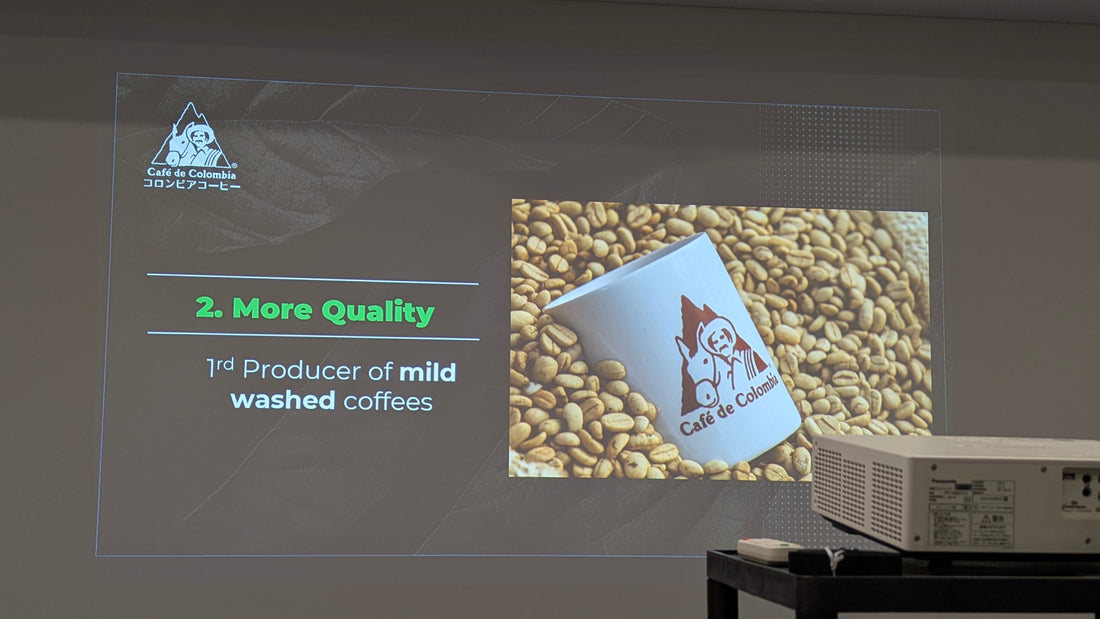
I attended a seminar hosted by the National Federation of Coffee Growers of Colombia (FNC) at SCAJ2025 (a specialty coffee exhibition). The speaker was Dr. Alvaro Gaitan, a plant pathologist at Colombia's Cenicafe (National Coffee Research Center). Colombia is the world's third largest coffee producing country after Brazil and Vietnam, and ranks first in the world for washed process coffee production. It is an origin Botarhythm simply cannot do without. So what thinking and technology are being layered together there right now? For me as a roaster, it was a time full of important insight.

Colombia's Topographic Gift, Nurtured by Rain and Mountains
Colombia is a distinctive country where "the rainy season comes twice a year." This comes from the Intertropical Convergence Zone (ITCZ), a weather band that shifts north and south near the equator, and the rainfall pattern it produces gives the country three harvest cycles.

Thanks to this geographic diversity, Colombian coffee ships year round. At the same time, harvesting is difficult and disease risk is high, and on the ground there is the added complexity of ripe and unripe cherries maturing on the tree at the same time.

Arabica, Rooted in Mountain Slopes
About 95% of the Arabica grown in Colombia spreads across mountain slopes, concentrated especially in the 1,500 to 2,000 meter elevation band. The temperature swings unique to this high altitude nurture the density and sweetness of the cherries.

That said, growing on sloped land lowers working efficiency and brings the added challenge of soil erosion. The fact that 61% of roughly 840,000 hectares of production land sits in this high altitude band shows how richness and hardship exist side by side.
The Science Behind Protecting What Makes Colombia, Colombia
The seminar introduced ongoing research and development of varieties that are both disease resistant and high quality. The well known Castillo variety has already spread nationwide, and in recent years an evolved version called "Castillo 2.0" was also introduced. This is the new variety I got to taste at the seminar I attended last year, and it stands as one source of hope against today's global warming. Coffee trees are typically replanted only about once every 20 years, which means what gets planted now decides the future.

Optimizing planting density (from 5,000 up to 10,000 trees per hectare), shade management (temperature control using shade trees), pH management, and other science based agricultural practices were being carefully put into place.
Commitment to Sustainability
What struck me most was the use of water and byproducts. For example, the amount of water once needed for washed processing was as much as 40 liters per kilogram. As a result of various efforts and the introduction of new technology, that figure has now dropped to just 0.5 liters.
They are also exploring ways to circulate 92% of byproducts such as pulp and parchment, not only as compost but as feed, fuel, and insect protein sources. I felt firsthand how this idea of "circulation" is supporting the future of coffee production.

Apps and AI, Connecting the Digital World to the Field
Cenicafe delivers technical support to farmers through a smartphone app. Image based disease lookup, work logging, and numerical tracking of drying conditions all make it possible to share on the ground challenges in real time.

The AI assistant "Adriana" supports English, Portuguese, and French, and Japanese support is reportedly being considered for the future. (I wonder about that one.)
Running a Hybrid Shop
This seminar left me once again feeling just how much wisdom and time from so many people supports the contents of every burlap sack that arrives from Colombia.
I roast here in nature rich Minamiboso, but before that one cup reaches someone's daily life, science and nature are working together in harmony on the other side of the globe. That is exactly why I want to stay honest with the heat and time of roasting too. Alongside sharpening the work only a person can do, roasting on the machine and talking with customers day to day, I also want to keep studying, including the latest technology such as generative AI, to deepen what I know. Across both the roastery in Chikura and the online store, I intend to keep working toward a hybrid way of running the shop.
Related Articles
Beans in the online store
For a first order, there is a tasting set of three roasts.
![[First-time only] Botarhythm Tasting Set of 3 (80g each) | Botarhythm specialty coffee](http://botarhythm.com/cdn/shop/files/LP_main.png?v=1765364144&width=480)


